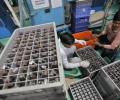
The automobile and auto-ancillary sector is expected to show strong Q3FY26 results, aided by festival-led demand, rationalisation in goods and services tax (GST) rates for select categories of vehicles, easing interest rates, and improving rural sentiment.

President Droupadi Murmu addressed Parliament, urging unity on national issues like 'Viksit Bharat', swadeshi, and national security. She highlighted government initiatives and the nation's progress.

Restoring weighted tax deductions and adopting a petty patents regime can foster firm-level innovative activity critical for competitiveness, points out Nagesh Kumar.

'While investors need to be prepared for making some losses, they should not lose big money chasing euphoria amid fear of missing out.'

Indication of a potential US Federal Reserve rate cut may trigger optimism in the domestic equity market, with investors' attention shifting to the looming deadline for additional US tariffs on Indian goods in a holiday-shortened week ahead, analysts said.

The idea of back-loading the target of fiscal consolidation is perhaps guided by the government's desire to be prepared for any adverse developments in the coming year, points out A K Bhattacharya.

The rupee slumped 5 per cent in 2025 as persistent capital outflows from foreign investors, alongside heightened dollar demand from importers, making it one of the worst-performing Asian currencies.

The rupee appreciated 53 paise to close at 89.67 against the US dollar on Friday, supported by corporate dollar inflows and easing crude oil prices. Forex traders said a positive trend in domestic equities and Brent crude oil prices hovering near $59 per barrel supported the domestic unit at lower levels.

'The first time India has seen two consecutive blockbuster IPO years.'

Global trends, tariff-related updates and trading activity of foreign investors would be the key drivers for the equity market movement this week, analysts said. Markets witnessed a strong rebound last week, with the benchmark indices surging over 4 per cent.

Indian automakers are reviving legacy nameplates to leverage brand recall and stand out in a crowded market, as classic badges like Sierra, Safari, Baleno and Scorpio return to attract buyers.

The recent selloff in the Indian equity market has been far more painful for mid and smallcap stocks compared to largecap stocks. The benchmark BSE Sensex is now down 9.5 per cent from its record monthly closing of 84,300 at the end of September last year. In the same period, the BSE MidCap has lost 17 per cent of its value, while the BSE SmallCap has corrected by 17.1 per cent.

The decision to hike US H-1B visa application fee to $100,000, trade talks and the GST rate cut will be the key drivers for stock market movement this week, analysts said.

New investors or those with lower-than-planned exposure should add US-oriented funds through SIPs.

'The frenzy for gold is primarily due to the uncertainty surrounding the tariff war.'

UBS, Credit Suisse see emerging markets doing well next year, but expect India to underperform, given its rich valuations.

Foreign investors continued their relentless selling in the Indian equity markets in August, offloading shares worth Rs 21,201 crore due to the unwinding of the yen carry trade, recession fears in the US and ongoing geopolitical conflicts. This came after an inflow of Rs 32,365 crore in July and Rs 26,565 crore in June, data with the depositories showed.

Securities and Exchange Board of India (Sebi) Chairman Tuhin Kanta Pandey on Thursday called for sharper disclosures in IPO (initial public offering) offer documents, particularly around risk factors, valuation rationale, objects of the issue, and utilisation of proceeds.

Domestic institutional investors (DIIs) have infused a record Rs 4.6 trillion into Indian equities over the course of Samvat 2080, marking the highest net annual investment in any Samvat to date. This robust domestic inflow has effectively counterbalanced the comparatively subdued investments from foreign portfolio investors (FPIs), who contributed a net Rs 90,956 crore within the same timeframe. Against this backdrop, the Nifty 50 and BSE Sensex indices are on track to achieve their best performance in three Samvat years, despite recent market corrections.

Noted ecologist Madhav Gadgil, known for his work on the conservation of Western Ghats, has passed away in Pune after a brief illness. He was 83.

Companies are squeezing more profits from their operations relative to the capital they put to work, the highest now since 2011. Profit after tax relative to capital employed came in at 10.47 per cent in September, shows data from the Centre for Monitoring Indian Economy (CMIE), higher than the 8.41 per cent seen in September last year. This is the highest since March 2010.

The ministry on Sunday decided to allow foreign individuals and pension funds, as well as other entities, to invest directly in equity markets.

India's private equity industry is evolving, with local funds securing substantial capital and achieving consistent returns. During a panel discussion at TiEcon Mumbai 2025, industry leaders emphasised growing opportunities in scaling buyouts and expanding domestic investor participation.

The country's banking system, while remaining "resilient" with bad loans at over a decade low and strong capital buffers, will continue to face intense competition from non-bank sources for resource mobilisation, said the Reserve Bank of India's (RBI's) Trend and Progress of Banking in India 2024-25 report.

India and the European Union (EU) on Tuesday announced the conclusion and finalisation of negotiations for the proposed free trade agreement (FTA).

The Reserve Bank of India (RBI), in its Financial Stability Report (FSR), cautioned that stress tests indicate two scheduled commercial banks (SCBs) may have to dip into their capital conservation buffers (CCBs), unless stakeholders infuse capital, under a scenario involving a gradual slowdown in domestic GDP growth and a moderate rise in inflation, with limited policy easing space available to the central bank.

The rupee recovered 55 paise from its all-time low level to close at 90.38 against the US dollar after a volatile trade on Wednesday, amid suspected aggressive central bank intervention.

Among Sensex firms, Mahindra & Mahindra climbed 2.34 per cent, followed by Maruti which climbed 1.70 per cent. Power Grid, Reliance Industries, Bharti Airtel and Eternal also were also among the gainers. However, ITC, HCL Tech, Tata Consultancy Services, Tech Mahindra and Infosys were among the laggards.

The derivatives expiry on Thursday is also expected to add to the volatility.

The government bond yield curve is likely to flatten in the financial year 2027 (FY27) as the Reserve Bank of India (RBI) is expected to ease supply pressure in the ultra-long segment. In FY26 so far, reduced investments by insurance companies and pension funds pushed up yields on ultra-long tenor securities, steepening the curve.

Investors and startup executives are calling for extending the period for an entity to be recognised as a startup from 10 to 15 years for deep-tech companies.

Ravi Kaushik has sold 70,000 units of air filters through his start-up Airth and aims to sell 10 lakh units in the next five years.

Foreign investors have pulled out Rs 22,420 crore from the Indian equity market so far this month, owing to high domestic stock valuations, increasing allocations to China, and the rising US dollar as well as Treasury yields. With this sell-off, Foreign Portfolio Investors (FPIs) have recorded a total outflow of Rs 15,827 crore in 2024 so far. As liquidity tightens, FPI inflows are expected to remain subdued in the short term.

It won't be an easy ride for the markets, reckon experts, considering the multiple state elections in 2018 and general elections next year.

'Only four or five original companies remain; the rest have been replaced every decade as sectors evolve or leadership shifts.' 'Companies that fail to adapt -- like many textile mills from the 1970s and shipping firms from the 1980s -- disappear.' 'Benchmark indices reward those who reinvent themselves in line with economic demands.'

From Rs 73k to over Rs 1.2L between January-December 2025 -- is buying gold in 2026 still sensible?

Domestic institutional investors (DIIs) poured in Rs 94,829 crore of fresh money into Indian equities in August, the second-highest monthly inflow after record Rs 1.07 trillion influx in October 2024.

India and the European Union are set to announce on January 27 the conclusion of negotiations and finalisation of a free trade agreement, which is aimed at boosting economic ties between the two regions amid disruptions in global trade due to US tariffs, an official said.

'We expect modest returns in 2026 versus the steep gains seen over the past few years.'

Among Sensex firms, Bharat Electronics, Eternal, Mahindra & Mahindra, Kotak Mahindra Bank, Tata Motors and Power Grid were the gainers. However, Adani Ports, ITC, UltraTech Cement and Titan were among the laggards.
